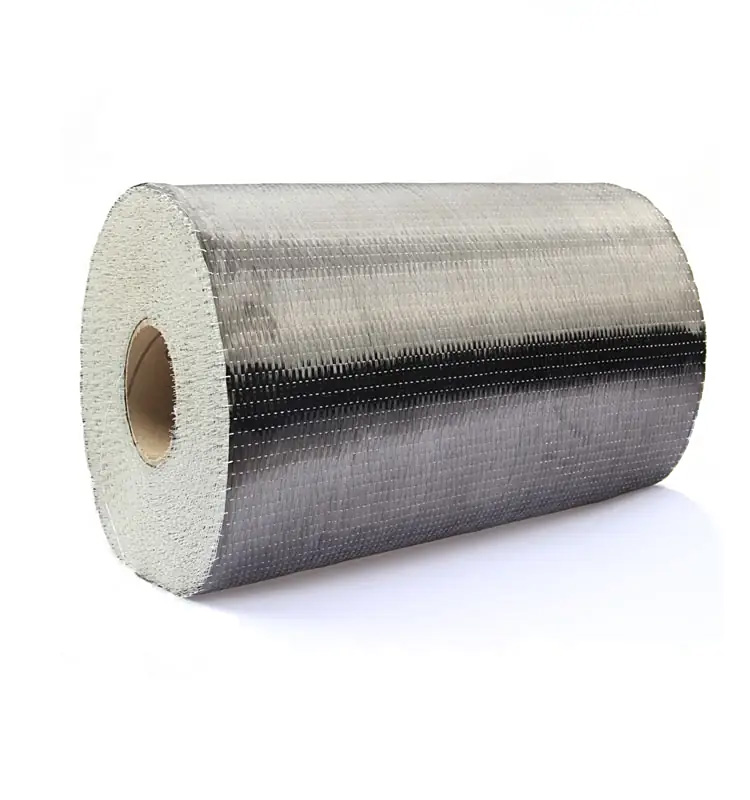
Carbon fiber cloth, also known as carbon fiber fabric or carbon fiber cloth, is a unidirectional carbon fiber reinforcement product woven from 12K carbon fiber filaments (each bundle contains 12,000 carbon filaments). It is primarily available in two thicknesses: 0.111mm (200g) and 0.167mm (300g), with widths ranging from 100mm, 150mm, 200mm, 300mm, and 500mm, as well as custom sizes. It features high strength, low density, and corrosion resistance. This material is bonded to concrete components using a matching impregnating adhesive and is widely used in construction, bridges, and tunnels.
The products are classified into three categories based on carbon fiber precursor: PAN-based, viscose-based, and bitumen-based. Among them, 12K carbon fiber cloth has become the mainstream choice for structural reinforcement due to its strong adhesive penetration and stable tensile properties. During construction, it is necessary to keep it away from power sources and control the ambient temperature between 5 and 35℃. A typical case is the 2014 Zhengzhou Ermalu Bridge reinforcement project across Zhengxing Street, which used carbon fiber cloth attached to the bridge structure to improve its stability. In 2024, the Chinese carbon fiber cloth market reached 7.713 billion yuan, with downstream applications covering building reinforcement, aerospace, and automotive lightweighting.
Product Features: High strength, low density, and thin thickness, with virtually no increase in the self-weight or cross-sectional dimensions of the reinforced component. Wide applicability, suitable for reinforcement, repair, seismic strengthening, and structural reinforcement of various structural types and shapes, including buildings, bridges, and tunnels. Convenient construction, requiring no large machinery or equipment, no wet work, no open flame, and no on-site fixed facilities; minimal site occupation and high construction efficiency. High durability; rust-free, making it ideal for use in highly acidic, alkaline, saline, and atmospheric corrosive environments.
Suitable for reinforcement and repair of various structural types and components, such as beams, slabs, columns, roof trusses, bridge piers, bridges, tubes, shells, etc. Applicable to the reinforcement and seismic strengthening of concrete, masonry, and timber structures in port engineering and water conservancy and hydropower projects, especially suitable for the reinforcement of complex structures with curved surfaces and joints. The strength requirement of the base concrete should not be lower than C15. The ambient temperature during construction should be within the range of 5–35℃, and the relative humidity should not exceed 70%.
|